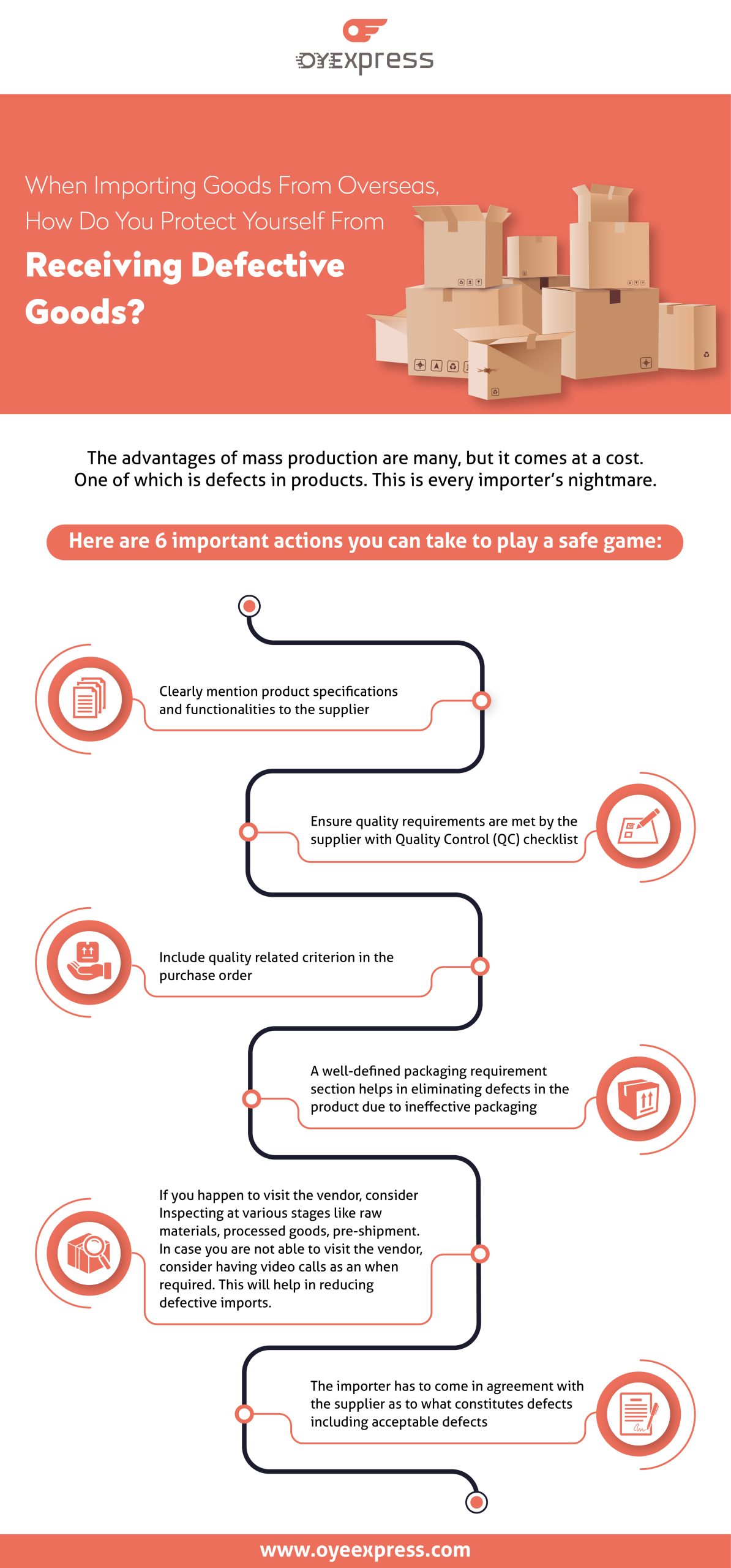
The advantages of mass production are many, but it comes at a cost. One of which is defects in products. This is every importer’s nightmare. Unfortunately, it cannot be wished away. However, there are a few steps one can take to safeguard against receiving defective goods.

Imagine this: You as an importer, is looking to start a business relationship with a new supplier. What are the key considerations regarding product quality that needs to be agreed upon?
Here are 6 important actions you can take proactively:
-
Clearly mention product specifications:
Eliminating defects completely is an ideal situation. But reality is different. You can limit the product defects by clearly mentioning product specifications and functionalities to the supplier. Take time out to discuss in detail what the product is intended to be used for. Clarify any doubts the supplier may have at this stage.
-
Quality Control (QC) checklist:
A QC checklist is a common tool used by importers to ensure quality requirements are met by the supplier. This document is shared with the supplier. The more detailed the QC checklist, lesser is the room for defects. This also needs to be a living document ie, as and when new defects are spotted, requisite quality controls need to be added to the QC checklist.
-
Including quality related criterion in the purchase order:
A common mistake is to exclude mentioning quality aspects in the purchase order. Mentioning it early in the business cycle in the form of inclusion in the purchase order helps keep a mutually agreed focus on quality production. This can be reiterated in other documents such as the vendor agreement, drawn subsequently.
-
Packaging specifications:
Defects in products due to ineffective packaging is a major area of concern for importers. These defects include the incorrect use of material for packaging or incorrect information displayed on the package, rendering the product defective/ unusable. A well defined packaging requirements section clarifies this critical aspect in the production process.

-
Inspections:
Pre-shipment inspections may consist of inspecting random samples of goods for QC adherence. This may not be fully effective. Instead, an importer may also insist on raw material inspection, during production inspection in addition to pre-shipment inspections. Further, some importers insist on monitoring container loading to ensure the goods are loaded correctly from the supplier’s end.
-
Penalty:
>The importer has to come in agreement with the supplier as to what constitutes defects, different categories of defects (including acceptable defects) and the recourse available to the importer in case of excessive defect rate.
In conclusion, by adopting the measures listed above, importers can save their time, money and business reputation. Knowing defects are an inherent part of mass production, it is better to be proactive in tackling them at the outset.